
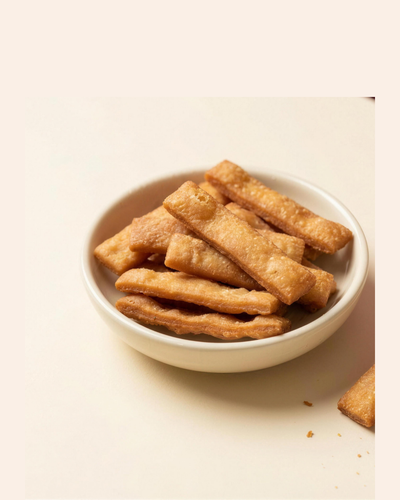
The Journey of Kurma: One Recipe, Two Worlds
The 180-year story of Kurma, from the khurma of Bihar and the 1845 voyage of the Fatel Razack to the small-batch tubs we craft in Gloucestershire.
Every snack has a story. Few carry one quite like Kurma.
A sweet with ancient roots
Kurma belongs to a large and ancient family of fried dough sweets found right across the Indian subcontinent. Its closest relative is shakkarpara, a diamond or finger shaped piece of fried dough finished in a crystallised sugar glaze, made across North India and Gujarat for Diwali, weddings and special occasions. Food historians trace the family further still, some believing it echoes shekarpareh, an older Persian sweet whose very name carries the word for sugar. That deeper lineage is folklore as much as fact, but the family resemblance is unmistakable.
The name we use points to a particular branch. The term khurma is most strongly associated with Bihar and Nepal, where the sweet is fried and then coated in sugar syrup, exactly as ours is.
How the recipe crossed an ocean
When slavery was abolished across the British Empire, plantation owners turned to a new system of indentured labour. From 1838, almost two million Indians travelled under contract to the Caribbean and far beyond. The first ship to reach Trinidad was the Fatel Razack, a teak vessel whose name means "Victory of God the Provider." She left Calcutta on 16 February 1845 and arrived in the Gulf of Paria on 30 May 1845, after 103 days and some 14,000 miles at sea, carrying 225 passengers. That day of arrival is still marked every year as Indian Arrival Day.
Most of those who came were from the regions of present day Bihar and Uttar Pradesh, the very heartland of khurma. It is why the strongest thread of evidence points to the Bihari khurma as the direct ancestor of Trinidadian Kurma. They carried their heritage in small bundles of spices and seeds, a little piece of home for a long road into the unknown.
Food as memory
Life on the estates was hard. Yet the response of the community was one of remarkable resilience, and food became its most powerful keepsake. Recipes passed from hand to hand, most often between women, and kept identity alive. Around nine in ten of those who arrived chose to make Trinidad their home, and in doing so they did not abandon their cooking. They transformed it, weaving a new Indo-Trinidadian cuisine into the island's national life. Kurma is one of its quiet triumphs.
The pag, the part that never changed
What makes a Kurma a Kurma is the pag, the crystallised sugar glaze. Hot sugar syrup is brought to exactly the right point, the freshly fried sticks are tossed through it, and as it cools it sets into a fine white frost. The Caribbean gave the recipe its own accent, a forward note of ginger where its Indian cousins might reach for rose water or saffron, but the technique of the pag travelled unbroken. The same skill, read by eye and by timing, has been practised in Bihar, in Diwali kitchens across Trinidad, and now in our kitchen too.
One recipe, two worlds
Traditionally, Kurma was made in great quantity and given away, to neighbours, to friends, to anyone who called by at Diwali. That spirit of generosity is the part of the story we hold onto most. When we make Kurma in small batches in Gloucestershire, we are not reinventing it. We are introducing it properly, with the care a recipe this old deserves.
One recipe. Two worlds. Still crossing.