
The Pag: The Small Window That Makes a Kurma
Dough, hot oil and a glaze with a mind of its own. Inside the slow, careful craft of handmaking Kurma in small batches.
Good Kurma cannot be rushed. It is made in small batches, by hand, and almost everything that matters happens in a few careful minutes.
It begins with the dough
The dough is simple and exacting at once: plain flour, a little butter or ghee, and milk to bring it together, warmed through with freshly grated ginger and the gentle spice of cardamom and cinnamon. It is kneaded firm, neither soft like a flatbread nor stiff like pastry, then left to rest. Ginger is the note that gives Caribbean Kurma its character, and we treat it with respect.
Hand-cut, every time
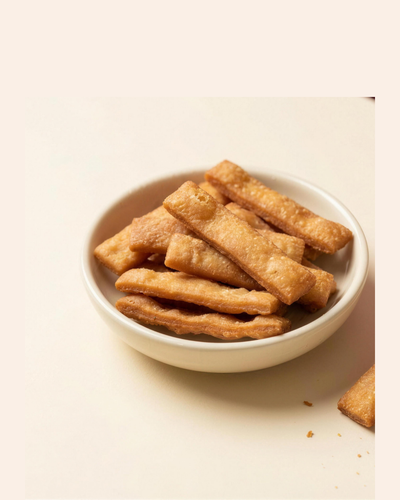
The rested dough is rolled and cut into short finger-length sticks. We cut by hand, which means no two pieces are ever quite identical. That small irregularity is not a flaw. It is the signature of something made by a person rather than a machine, and it is part of why each batch has character.
The fry
The sticks are fried in batches over a steady, moderate heat until they are golden right through. Too hot and the outside colours before the centre is done. Too cool and they drink the oil. Reading that balance is craft knowledge, learned by doing, and there is no shortcut for it.
The pag, the moment of truth
Then comes the pag, the crystallised sugar glaze that defines a Kurma. Sugar and water are boiled to a precise point, and the hot fried sticks are tossed through the syrup so every surface is coated. As it cools, the glaze sets into a fine white frost. The window is small and unforgiving. A touch undercooked and the syrup soaks in and turns the Kurma soft. A touch over and it seizes before it can coat. Knowing the exact moment to add the sticks is the mark of an experienced maker, and it is the part of the process we are proudest of.
Why small batch
We make Kurma the slow, careful way in our kitchen in Gloucestershire, never mass-produced, because this is a recipe that rewards attention. Small batches let us watch every stage and hold every piece to the same standard. Even our used frying oil is collected and recycled into biofuel, a small thing, but the kind of detail that matters to us.
It would be easier to make it faster. It would not be better.